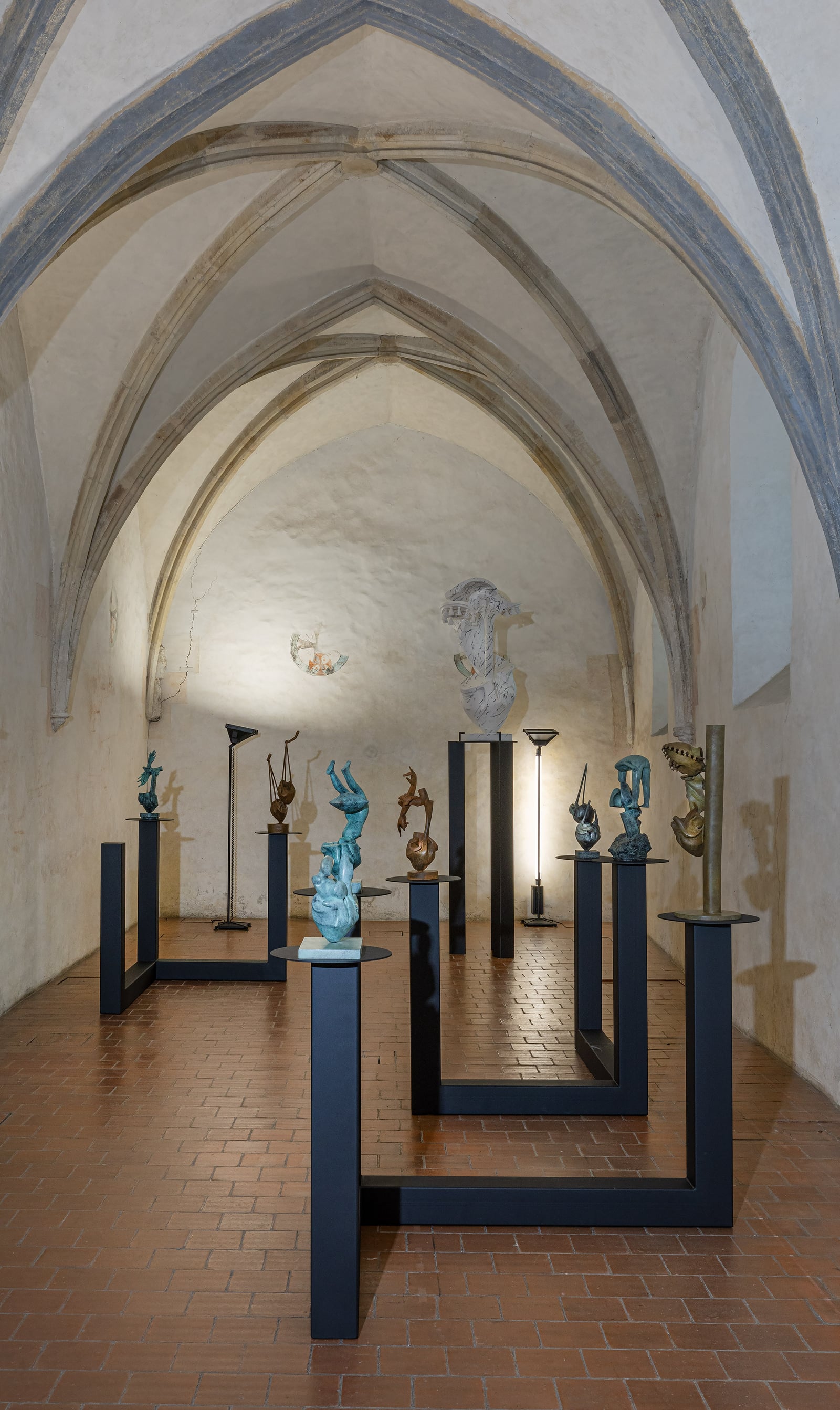
The exhibition A Private Matter at the Museum of Modern Art presents not only a cross-section of Zbyněk Sekal’s (1926–1998) work, but primarily attempts to open up his inner world to the viewer as a space of memory, anxiety, order, and silence. Alongside selected sculptures, assemblages, and boxes, his own words in the form of diary excerpts and personal thoughts enter the exhibition, creating intimate coordinates of the artist's human presence. The exhibition is made possible by a donation to the Olomouc Museum of Art collection from the estate of the artist's wife, Christine Sekal.
Zbyněk Sekal’s artistic work is imbued with deep personal experience and existential angst. He was an exceptionally focused and solitary man, marked by war, imprisonment, and time spent in a concentration camp. He coped with the experience of extreme chaos by needing to find order in the things around him and to create a new whole from their fragments. This principle permeates his entire body of work — from early sculptures in the 1950s, through hanging assemblages of found objects and used materials from the 1960s, to the intricately and strictly composed boxes he intensely pursued from the 1980s.
Information about the exhibition
EXHIBITION: Zbyněk Sekal: A Private Matter. Insights into the Olomouc Museum of Art Collections
DATE: 01 07 – 04 10 2026
VENUE: Museum of Modern Art, Gallery
CURATORS: Olga Š. Staníková, Klára Jeništová
TRANSLATION AND LANGUAGE EDITING: Zuzana Henešová
INSTALLATION: Vlastimil Sedláček, Filip Šindelář, Radka Žáková
SOUND REALIZATION: Kamil Zajíček, Petr Votoček
ELECTRICAL INSTALLATION: Dušan Sapara
GRAPHIC DESIGN: Kateřina Manková
EDUCATIONAL PROGRAMS: Denisa Tessenyi, David Hrbek
The exhibition was made possible by a donation to the Olomouc Museum of Art from the estate of the artist's wife Christine Sekal.
QR code with a link to the audio guide for the Zbyněk Sekal exhibition A Private Matter. Scan the QR code and return to Zbyněk Sekal's thoughts in the Cabinet of Wonders application. You will find more excerpts from his diaries here, the option to ask an AI guide. All in 11 languages.
In addition to sculptural work, Sekal dedicated himself to drawing, collages, graphic design for book covers, and translations of demanding German philosophical and literary texts. At the same time, he formulated his own original texts and kept diaries, which today represent a unique key to understanding his thinking and artistic work. These diary entries become one of the important axes of this exhibition — not as a mere commentary on the work, but as its natural part. As the author's voice, which remains silent, yet urgent.
Besides existentialism, Sekal was strongly influenced by Art Informel, and although he remained a distinct solitaire, his work belonged to the broader circle of post-war European art, reacting to the breakdown of certainties and the search for a new language after the war. The need to withdraw from the surrounding world and the pressure of the contemporary regime led him to a certain form of internal emigration even before his actual departure after 1968 and subsequent settlement in Vienna. There he found his new studio, where he spent long hours in concentrated work alone, surrounded only by his works and an endless amount of material, and where over the years he built a protective microworld.
Sekal's work can appear quiet, sometimes even withdrawn. Yet — or precisely because of this — it has the ability to address one very personally. It does not impose an interpretation or offer unambiguous answers. Rather, it creates a space in which one can pause for a moment and enter a concentrated silence. Perhaps it is here that his work opens up the most: as a patient assembly of the world from fragments, as an attempt to capture what otherwise falls apart, and as a silent, yet urgent testimony to human experience.

Zbyněk Sekal: A Private Matter
Ends in 12 days